
by
Damien F. Mackey
“In the understanding of the people of the Near East at that time,
[Ashurnasirpal II] really was “king of the world”.”
Joshua J. Mark
Dreams, visions, superstition, megalomania, cruelty, fiery furnace, messing with the rites, building of Babylon, mysterious and enduring illness, madness, conquest of Egypt -
these were some of the ‘symptoms’ exhibited by the bunch of Assyro-Babylonian (Persian) ‘kings’ whom I lumped together as being various faces of the one historical Nebuchednezzar.
Names such as:
Esarhaddon who, deliberately reading the specified ritual number upside down, rebuilt Babylon, who also suffered a long, dreadful and alienating illness, and who attacked Egypt.
Ashurbanipal whose 43-year reign was the same length as Nebuchednezzar’s, who burned his brother in a fiery furnace, and who absolutely smashed Egypt.
Nabonidus who is regarded by some biblical commentators and historians as being the true model for the ‘Nebuchadnezzar’ of the Book of Daniel. Highly pious, superstitious, suffering from madness and foreboding dreams.
Cambyses who was also quite mad, and whose other name was “Nebuchednezzar”, and who, too, conquered Egypt.
All of this is set out in my multi-part series:
beginning with:
Now I have a new candidate for consideration, Ashurnasirpal (especially II).
This king has been, to date, a real headache for revisionists to place in any satisfactory way. And that same statement applies even more to his supposed son, Shalmaneser III, who initially ended up straddling the mid-C9th BC right where Dr. I. Velikovsky had located the El Amarna [EA] period, prompting Velikovsky to attempt identifying Shalmaneser III with the Kassite ruler of Babylonia at the time of EA, Burnaburiash II (c. 1359 – 1333 BC, conventional dates).
A suggested folding of
‘Middle’ and ‘Neo’ Assyria
“As we know from the correspondence left by the roya1 physicians and exorcists … [Esarhaddon’s] days were governed by spells of fever and dizziness, violent fits of vomiting, diarrhoea and painful earaches. Depressions and fear of impending death”.
Following on from my tentative identification of Tukulti-Ninurta I as the neo-Assyrian king, Sennacherib (a connection originally suggested by Phillip Clapham):
Can Tukulti-Ninurta I be king Sennacherib?
I must now consider the possibility that “Ashurnasirpal”, said to have been the son-successor of a Tukulti-Ninurta (II), was the actual successor of Sennacherib, that is, Esarhaddon, who is, in turn, in my scheme of things, Nebuchednezzar himself:
"As we know from the correspondence left by the roya1 physicians and exorcists … his days were governed by spells of fever and dizziness, violent fits of vomiting, diarrhoea and painful earaches. Depressions and fear of impending death... more
Nor is there any surprise in learning that ‘The Marduk Prophecy’ bears striking parallels with Esarhaddon’s inscriptions for the same reason (Esarhaddon is Ashurbanipal). And, according to this present series, Esarhaddon (Ashurbanipal) is... more
See also my:
Aligning Neo-Babylonia with Book of Daniel. Part Two: Merging late neo-Assyrians with Chaldeans
Admittedly this is something of a long stretch in the present scheme of things.
While, fittingly, the father of Tukulti-Ninurta I is said to have been a Shalmaneser – just as in my revision the father of (Sargon II =) Sennacherib was a Shalmaneser, his son is said to have been one Ashur-nadin-apli.
Tukulti-Ninurta II, on the other hand, who was the father of Ashurnasirpal II, is said to have had a father named Adad-nirari (II). Tukulti-Ninurta II, though, does not even rate a mention in the index at the back of Marc Van de Mieroop’s text, A History of the Ancient Near East ca. 3000-323 BC.
Putting it all together, I would tentatively suggest this sequence:
Putting it all together, I would tentatively suggest this sequence:
Shalmaneser (I, III);
Tukulti-Ninurta (I, II);
Ashur-nadin-apli-Ashurnasirpal (I, II)
equates to, respectively:
Shalmaneser (V);
Sargon II-Sennacherib;
Esarhaddon-Ashurbanipal-Nebuchednezzar
Joshua J. Mark tells us much about this great and cruel king in his article, “Ashurnasirpal II”: https://www.ancient.eu/Ashurnasirpal_II/ some of which I give here with my comments added:
Ashurnasirpal II (reigned 884-859 BCE) was the third king of the Neo-Assyrian Empire. His father was Tukulti-Ninurta II (reigned (891-884 BCE) whose military campaigns throughout the region provided his son with a sizeable empire and the resources to equip a formidable army.
My comment: If the revision that I am putting together in this series - albeit tentatively - is heading in the right direction, then these dates for Ashurnasirpal and his father are far too high.
The “father”, Tukulti-Ninurta so-called II, who does not even rate an entry in the index at the back of Van de Mieroop’s book (as we have already found), stands sorely in need of a significant alter ego, that being, as I have suggested, none other than Sargon II-Sennacherib.
Ashurnasirpal II is known for his ruthless military conquests and the consolidation of the Assyrian Empire, but he is probably most famous for his grand palace at Kalhu (also known as Caleh and Nimrud in modern-day Iraq), whose wall reliefs depicting his military successes (and many victims) are on display in museums around the world in the modern day. In addition to the palace itself, he is also known for throwing one of the most impressive parties in history to inaugurate his new city of Kalhu: he hosted over 69,000 people during a ten day festival. The menu for this party still survives in the present day.
My comment: One of my alter egos for Ashurnasirpal is Esarhaddon, who was indeed interested in Kalhu: http://oracc.museum.upenn.edu/nimrud/ancientkalhu/thecity/latekalhu/index.html
.... Esarhaddon, however, took a great deal of interest in the city. Around 672 BC, towards the end of his reign, he rebuilt part of the city wall and made significant improvements to Fort Shalmaneser. He added a new terrace and created an impressive new entrance consisting of a vaulted ramp which led from a newly-rebuilt postern gate TT directly into the palace through a series of painted rooms. Inscriptions on both sides of the gate commemorated this construction work, as did clay cylinders which were perhaps originally deposited inside Fort Shalmaneser's walls ....
It is possible that Esarhaddon's activities at Kalhu were intended as a prelude to reclaiming it as royal capital. There is some, albeit very limited evidence, that he may have lived at Kalhu briefly towards the end of his reign: a partially preserved letter mentions that the king's courtiers "are all in Kalhu", perhaps indicating that the court had moved there from Nineveh (SAA 13: 152). ....
My comment: As for Ashurnasirpal’s being “ruthless”, his cruelty is legendary (see below). And in this he resembles his other alter ego, Ashurbanipal (‘Ashur is the creator of an heir’), whose name is almost identical to Ashurnasirpal (‘Ashur is guardian of the heir’).
The following piece tells of Ashurnasirpal’s, of Ashurbanipal’s overt cruelty:
Many Kings of Assyrian had displayed proudly their cruelty towards their enemies. Sometimes in reliefs or in their annals, New Assyrian [kings] gave detail[s] of their gory exploits against their opponents.
King Ashurnasirpal laid out many of his sadistic activities in one of his annals. He liked burning, skinning, and decapitating his enemies. When he defeated a rebelling city, he made sure they [paid] a huge price. Disobedient cities were destroyed and razed to the ground with fire, with their wealth and all material riches taken by the king. Their youth and women were either burned alive or made into slaves or placed into the harem. In the City of Nistun, Ashurnasirpal showed how he cut [off] the heads of 260 rebelling soldiers and piled it together.
Their leader named Bubu suffered horrific punishment. He was flayed and his skin was placed in the walls of Arbail.
In the city of Suri, rebelling nobles were also skinned and were displayed like trophies. Some skin were left to rot but some were placed in a stake. Officials of the city suffered decapitation of their limbs. The leader of the Suri rebellion, Ahiyababa, underwent flaying and his skin was then placed in the walls of Niniveh. After Ashurnasirpal defeated the city of Tila, he ordered to cut the hands and feet of the soldiers of the fallen city. Other than that, some soldiers found themselves without noses and ears. But also, many defeated soldiers had their eyes gouged out. The heads of the leaders of the Tila were hang[ed] in the trees around the city.
Ashurnasirpal was not alone in having a psychotic mind. Many of his successors followed his brutality towards enemies.
....
The intellectual King Ashurbanipal also had a share of cruelty. Although he was known for his great library in Nineveh, he was not as merciful as he seemed. One time, an Arabian leader name Uaite instigated a rebellion. Ashurbanipal managed to defeat Uaite and captured him and brought back to Niniveh. There, he brought upon a humiliating punishment. He was tied like a dog and placed in a kennel alongside with dogs and jackals guarding the gates of the great Assyrian capital of Nineveh. ....
The Book of Daniel’s “Nebuchadnezzar” was likewise an insane and cruel king, he being perhaps “the basest of men” (4:17): https://biblehub.com/commentaries/daniel/4-17.htm
And setteth over it the basest of men — If this be applied to Nebuchadnezzar, it must be understood, either with respect to his present condition, whose pride and cruelty rendered him as despicable in the sight of God as his high estate made him appear honourable in the eyes of men; and, therefore, was justly doomed to so low a degree of abasement: or else it may be interpreted of his wonderful restoration and advancement after he had been degraded from his dignity. ....
He reigned for 25 years and was succeeded by his son, Shalmaneser III, who reigned from 859-824 BCE.
My comment: If the revision that I am putting together in this series - albeit tentatively - is heading in the right direction, then Ashurnasirpal’s reign was far longer than “25 years”, was 43 years. And Shalmaneser was not his “son”, but his grandfather.
Early Reign and Military Campaigns
... by the time Ashurnasirpal II came to the throne, he had at his disposal a well-equipped fighting force and considerable resources.
He put both of these to use almost at once. He was not so much interested in expansion of the empire as in securing it against invasion from without or rebellion from within.
My comment: Ashurnasirpal was very much “interested in expansion of the empire”.
When fitted with his alter egos, he becomes the conqueror of even the distant land of Egypt.
He also was required, as an Assyrian king, to combat the forces of chaos and maintain order. The historian Marc Van De Mieroop writes, “The king, as representative of the god Assur, represented order.
Wherever he was in control, there was peace, tranquility, and justice, and where he did not rule there was chaos. The king’s duty to bring order to the entire world was the justification for military expansion” (260). While Ashurnasirpal may not have considered expansion a priority, he certainly took order in his realm very seriously and would not tolerate insubordination or revolt.
His first campaign was in 883 BCE to the city of Suru to put down a rebellion there. He then marched to the north where he put down other rebellions which had broken out when he took the throne. He was not interested in having to expend more time and resources on future rebellions and so made an example of the rebels in the city of Tela. In his inscriptions he writes:
I built a pillar over against the city gate and I flayed all the chiefs who had revolted and I covered the pillar with their skins. Some I impaled upon the pillar on stakes and others I bound to stakes round the pillar. I cut the limbs off the officers who had rebelled. Many captives I burned with fire and many I took as living captives. From some I cut off their noses, their ears, and their fingers, of many I put out their eyes. I made one pillar of the living and another of heads and I bound their heads to tree trunks round about the city. Their young men and maidens I consumed with fire. The rest of their warriors I consumed with thirst in the desert of the Euphrates.
My comment: Interestingly, Joshua J. Mark (“Assyrian Warfare”) applies this horrific Suru episode instead to Ashurbanipal:
The Assyrian kings were not to be trifled with and their inscriptions vividly depict the fate which was certain for those who defied them. The historian Simon Anglim writes:
The Assyrians created the world's first great army and the world's first great empire. This was held together by two factors: their superior abilities in siege warfare and their reliance on sheer, unadulterated terror. It was Assyrian policy always to demand that examples be made of those who resisted them; this included deportations of entire peoples and horrific physical punishments. One inscription from a temple in the city of Nimrod records the fate of the leaders of the city of Suru on the Euphrates River, who rebelled from, and were reconquered by, King Ashurbanipal:
“I built a pillar at the city gate and I flayed all the chief men who had revolted and I covered the pillar with their skins; some I walled up inside the pillar, some I impaled upon the pillar on stakes."
My comment: In the Babylonian Chronicles Nebuchednezzar mentions his conquest of Suru: “The king of Suru; the king of Hazzati ...”.
This treatment of defeated cities would become Ashurnasirpal II’s trademark and would include skinning insubordinate officials alive and nailing their flesh to the gates of the city and “dishonoring the maidens and boys” of the conquered cities before setting them on fire.
With Tela destroyed, he moved swiftly on to other campaigns. He marched west, fighting his way through other rebel outbreaks and subjugating the cities which opposed him. The historian John Boardman notes that “a major factor behind the increasing resistance was probably the heavy tribute exacted by Ashurnasirpal…one has the impression that a particularly large amount of booty was claimed by this king and that corvee [forced labor] was imposed universally” (259). Ashurnasirpal II led his army on successful campaigns across the Euphrates River and all the way to the Mediterranean Sea, where he washed his weapons as a symbol of his conquests (an act made famous by the inscriptions of Sargon the Great of the earlier Akkadian Empire after he had established his rule).
My comment: Ashurbanipal, likewise, ‘washed his weapons in the Sea’ (Warfare, Ritual, and Symbol in Biblical and Modern Contexts, p. 223): “Inscriptions from ... Ashurnasirpal II ... and Ashurbanipal ... record washing their weapons in the Mediterranean Sea and offering sacrifices ...”.
Although some sources claim he then conquered Phoenicia, it seems clear he entered into diplomatic relations with the region, as he did also with the kingdom of Israel. The surviving populaces of the cities and territories he conquered were, as per Assyrian policy, relocated to other regions in the empire in order to distribute skills and talent.
My comment: If Ashurnasirpal were also Esarhaddon-Ashurbanipal-Nebuchednezzar, as I am proposing, then he most certainly conquered Phoenicia, Israel, and more. For example:
Esarhaddon:
.... the Assyrian king Esarhaddon (r.680-669) tightened the Assyrian grip on the cities of Phoenicia. Sidon was sacked in 677/676 and its people were deported. In the next year, 676/675, the cities of Syria and Cyprus were ordered to contribute building materials for a monument in Nineveh.
The inscription mentions two groups of contributing kings: those ruling over the Levantine cities and those ruling the colonies in the west. It also mentions their tributes. The text has attracted considerable attention because it also mentions King Manasseh of Judah, who ruled from 687 to 642. ....
Esarhaddon's Prism B
[1] I called up the kings of the country Hatti and (of the region) on the other side of the river Euphrates: Ba'al, king of Tyre; Manasseh, king of Judah; Qawsgabar, king of Edom; Musuri, king of Moab; Sil-Bel, king of Gaza; Metinti, king of Ashkelon; Ikausu, king of Ekron; Milkiashapa, king of Byblos; Matanba’al, king of Arvad; Abiba'al, king of Samisimuruna; Puduil, king of Beth-Ammon; Ahimilki, king of Ashdod ....
Ashurbanipal:
Ashurbanipal overcame chaos by conquering Egypt, campaigning against Phoenician Tyre, and warring against the Elamites of south-western Iran. One of the most arresting sculptures in the exhibition shows him dining with his wife in the luxurious gardens of his palace in the aftermath of his victory over Elam. He reclines beneath a particularly luscious grapevine (his gardens were irrigated by a network of artificial channels); the head of the Elamite king is staked on the branch of a tree. ....
Nebuchednezzar:
... in 589BC, Zedekiah rebelled against Nebuchadnezzar and Jerusalem was beseiged again for over a year and a half before finally falling in 587BC. The Temple was destroyed and the population was taken into exile in Babylonia (see 2 Kings 25:1-10).
Nebuchadnezzar then proceeded to conquer Phoenicia in 585BC and to invade Egypt in 567BC. The dominance of Babylonia only came to an end when King Cyrus of Persia captured Babylon in 539 BC, and Babylonia became part of the Persian Empire (see Ezra 1:1).
Having accomplished what he set out to do on campaign, he turned around and headed back to his capital city of Ashur. If there were any further revolts to be put down on his march back, they are not recorded. It is unlikely that there were more revolts, however, as Ashurnasirpal II had established a reputation for cruelty and ruthlessness which would have been daunting to even the most ardent rebel. The historian Stephen Bertman comments on this, writing:
Ashurnasirpal II set a standard for the future warrior-kings of Assyria. In the words of Georges Roux, he `possessed to the extreme all the qualities and defects of his successors, the ruthless, indefatigable empire-builders: ambition, energy, courage, vanity, cruelty, magnificence’ (Roux 1992:288). His annals were the most extensive of any Assyrian ruler up to his time, detailing the multiple military campaigns he led to secure or enlarge his nation’s territorial dominion. From one raid alone he filled his kingdom’s coffers with 660 pounds of gold an equal measure of silver, and added 460 horses to his stables. The sadistic cruelty he inflicted upon rebel leaders was legendary, skinning them alive and displaying their skin, and cutting off the noses and the ears of their followers or mounting their severed heads on pillars to serve as a warning to others (79-80).
.... His famous Standard Inscription told again and again of his triumphs in conquest and vividly depicted the horrible fate of those who rose against him. The inscription also let the dignitaries from his own realm, and others, know precisely who they were dealing with. He claimed the titles “great king, king of the world, the valiant hero who goes forth with the help of Assur; he who has no rival in all four quarters of the world, the exalted shepherd, the powerful torrent that none can withstand, he who has overcome all mankind, whose hand has conquered all lands and taken all the mountain ranges” (Bauer, 337). His empire stretched across the territory which today comprises western Iran, Iraq, Syria, Jordan, and part of Turkey. Through his diplomatic relationships with Babylonia and the Levant, he also had access to the resources of southern Mesopotamia and the sea ports of Phoenicia. In the understanding of the people of the Near East at that time, he really was “king of the world”.
“Nebuchadnezzar Syndrome”:
Dreams, visions: “Assurnasirpal built a palace and a temple for the dream god Mamu ...”:
Megalomania, cruelty: “Ashurnasirpal II is the epitome of everything you would ever want out of a psychotically deranged vengeance-sucking ancient conquest-mongering megalomaniac who drove his jet-fuel-powered chariot across a road paved with corpses so he could kill a lion with his fists”. http://www.badassoftheweek.com/index.cgi?id=461274131521
Fiery furnace, lions’ den: “Many captives I burned with fire”
“The Assyrian king Ashurnasirpal II (883-859 BC) is reported to have maintained a breeding farm for lions at Nimrud”. http://www.jesuswalk.com/daniel/3_faithfulness.htm
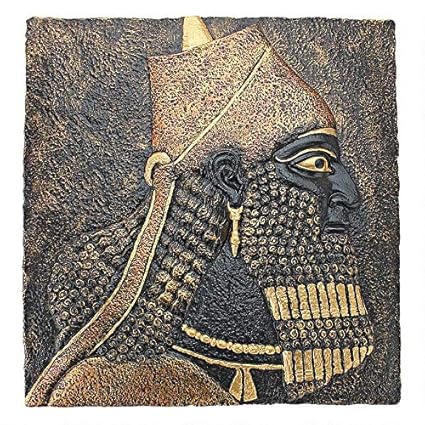
Messing with the rites (unorthodox): “Ashurnasirpal II holding a bowl, detail of a relief. Note the King’s facial expression, headgear, hair, earring, necklace, mustache, beard, wrist bracelet, armlets, daggers, and the bowl he holds with his right hand. The left hand holds a long royal staff. The King’s attire is superb. What is unusual in this scene is that the King’s royal attendant is “taller” than the King himself!”
Mysterious and enduring illness: His prayer to the goddess Ishtar ... “lamentation over the kings underserved suffering for a persistent illness” (Donald F. Murray, Divine Perogative and Royal Pretension: Pragmatics, Poetics and Polemics ..., pp. 266-267):
....
I have cried to thee, suffering, wearied, and distressed, as thy servant.
See me O my Lady, accept my prayers.
Faithfully look upon me and hear my supplication.
Promise my forgiveness and let thy spirit be appeased.
Pity! For my wretched body which is full of confusion and trouble.
Pity! For my sickened heart which is full of tears and suffering.
Pity! For my wretched intestines (which are full of) confusion and trouble.
Pity! For my afflicted house which mourns bitterly.
Pity! For my feelings which are satiated with tears and suffering.
O exalted Irnini, fierce lion, let thy heart be at rest.
O angry wild ox, let thy spirit be appeased.
Let the favor of thine eyes be upon me.
With thy bright features look faithfully upon me.
Drive away the evil spells of my body (and) let me see thy bright light.
How long, O my Lady, shall my adversaries be looking upon me,
In lying and untruth shall they plan evil against me,
Shall my pursuers and those who exult over me rage against me?
How long, O my Lady, shall the crippled and weak seek me out?
One has made for me long sackcloth; thus I have appeared before thee.
The weak have become strong; but I am weak.
I toss about like flood-water, which an evil wind makes violent.
My heart is flying; it keeps fluttering like a bird of heaven.
I mourn like a dove night and day.
I am beaten down, and so I weep bitterly.
With "Oh" and "Alas" my spirit is distressed.
I - what have I done, O my god and my goddess?
Like one who does not fear my god and my goddess I am treated;
While sickness, headache, loss, and destruction are provided for me;
So are fixed upon me terror, disdain, and fullness of wrath,
Anger, choler, and indignation of gods and men.
I have to expect, O my Lady, dark days, gloomy months, and years of trouble.
I have to expect, O my Lady, judgment of confusion and violence.
Death and trouble are bringing me to an end.
Silent is my chapel; silent is my holy place;
Over my house, my gate, and my fields silence is poured out.
As for my god, his face is turned to the sanctuary of another.
My family is scattered; my roof is broken up.
(But) I have paid heed to thee, my Lady; my attention has been turned to thee.
To thee have I prayed; forgive my debt.
Forgive my sin, my iniquity, my shameful deeds, and my offence.
Overlook my shameful deeds; accept my prayer;
Loosen my fetters; secure my deliverance;
Guide my steps aright; radiantly like a hero let me enter the streets with the living.
See me O my Lady, accept my prayers.
Faithfully look upon me and hear my supplication.
Promise my forgiveness and let thy spirit be appeased.
Pity! For my wretched body which is full of confusion and trouble.
Pity! For my sickened heart which is full of tears and suffering.
Pity! For my wretched intestines (which are full of) confusion and trouble.
Pity! For my afflicted house which mourns bitterly.
Pity! For my feelings which are satiated with tears and suffering.
O exalted Irnini, fierce lion, let thy heart be at rest.
O angry wild ox, let thy spirit be appeased.
Let the favor of thine eyes be upon me.
With thy bright features look faithfully upon me.
Drive away the evil spells of my body (and) let me see thy bright light.
How long, O my Lady, shall my adversaries be looking upon me,
In lying and untruth shall they plan evil against me,
Shall my pursuers and those who exult over me rage against me?
How long, O my Lady, shall the crippled and weak seek me out?
One has made for me long sackcloth; thus I have appeared before thee.
The weak have become strong; but I am weak.
I toss about like flood-water, which an evil wind makes violent.
My heart is flying; it keeps fluttering like a bird of heaven.
I mourn like a dove night and day.
I am beaten down, and so I weep bitterly.
With "Oh" and "Alas" my spirit is distressed.
I - what have I done, O my god and my goddess?
Like one who does not fear my god and my goddess I am treated;
While sickness, headache, loss, and destruction are provided for me;
So are fixed upon me terror, disdain, and fullness of wrath,
Anger, choler, and indignation of gods and men.
I have to expect, O my Lady, dark days, gloomy months, and years of trouble.
I have to expect, O my Lady, judgment of confusion and violence.
Death and trouble are bringing me to an end.
Silent is my chapel; silent is my holy place;
Over my house, my gate, and my fields silence is poured out.
As for my god, his face is turned to the sanctuary of another.
My family is scattered; my roof is broken up.
(But) I have paid heed to thee, my Lady; my attention has been turned to thee.
To thee have I prayed; forgive my debt.
Forgive my sin, my iniquity, my shameful deeds, and my offence.
Overlook my shameful deeds; accept my prayer;
Loosen my fetters; secure my deliverance;
Guide my steps aright; radiantly like a hero let me enter the streets with the living.
....

