Powered By Blogger

Sunday, October 6, 2019

Critic argues ‘Genesis not written by Moses in MBI’


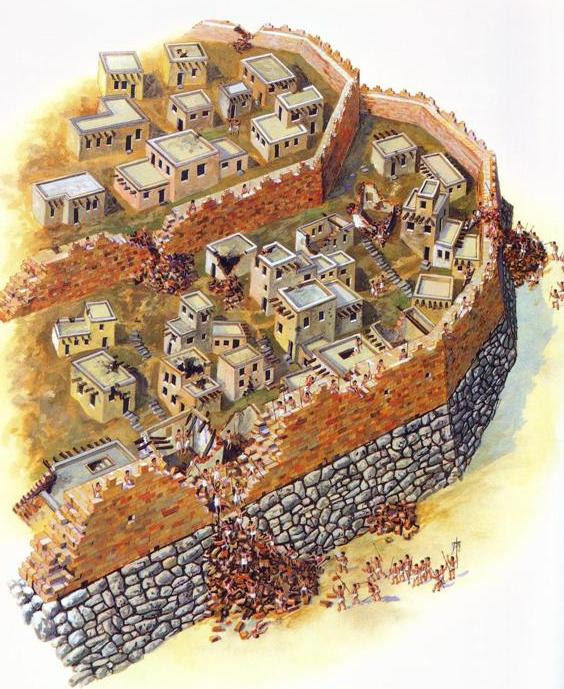
Reconstruction of ancient Jericho, with outer and inner walls, walls in bad repair, and houses/rooms built into the outer wall itself; the collapsed walls made it much easier for Joshua and the Israelites to gain access to the city


by


Damien F. Mackey


Against my fundamental archaeological view (following the likes of Cohen, Anati, and Osgood) that the Exodus Israelites were the Middle Bronze I people, conquerors of EBIII/IV Palestine and Transjordan, a reader has thrown up in opposition to this what he considers to be archaeological anomalies, places such as Elealeh and Bozrah whose earliest levels, he claims, well post-date MBI.  


Dear Mr. Damien Mackey, I just read your article posted on Academia subtitled Middle Bronze I Israelites, in which you seem to prefer an Exodus at this period of time, citing the work of Rudolph Cohen. The problem? The Bible states that Moses's Israelites conquered the city of Elealeah and that Reuben settled there (Numbers 32:3, 37). "And...the sons of Reuben...built...Heshbon, Elealeh..." It is identified today with El-Al and it is no earlier than Iron Age I. No Bronze Age sherds have ever been found there (see p. 116. Burton MacDonald. East of the Jordan, Territories and Sites of the Hebrew Scriptures. Boston, American School of Oriental Studies. 2000). "The Hebrew Wlealeh is preserved in the archaeological site of El-Al located 3 km northeast of Tall Hisban...Glueck found no Bronze Age sherds at the site, he did find numerous Early Iron I and II, some Hellenistic, and... medieval sherds...Iron I and Iron II, Persian sherds among those Ibach collected at the site (1987:11)..." Heshbon, also built with Eleahleh, has no Middle Bronze I sherds either, it is Iron Age too. MacDonald: "...the archaeological evidence does not support the location of an Amorite capital city at Tall Hisban in either the Late Bronze or Early Iron Ages." (p.93, MacDonald)I doubt that most archaeologists would endorse Elealeh and Heshbon being in existence in Middle Bronze I for Moses to capture and Reuben to settle at. ....


I replied:


Thank you very much for that ....

.... Sometimes, as you would know, biblical sites have been wrongly identified.

Regarding Judith of Simeon's important town of "Bethulia", for instance, I had been following C. R. Conder's view that it was modern Mesilieh (or Mithilia).

But now I believe that Charles C. Torrey absolutely nailed it, as Shechem.

See e.g. my:


"Judith's City of 'Bethulia'. Part Two (ii): Shechem".

https://www.academia.edu/34737759/Judiths_City_of_Bethulia._Part_Two_ii_Shechem
and
https://www.academia.edu/36533218/Judiths_City_of_Bethulia._Part_Two_iii_Shechem_continued_

My best wishes,

Damien.


Later, I was critical of the methodology of a critic’s picking out a site, or two, of apparent anomaly, whilst ignoring the vast evidence that is now available from revisionists for a basic overlay of MBI sites upon the biblical places of occupation during the Conquest:   

....

Are you sure that these ... sites have been properly identified ...?


For you to hold up just one place, your initial example of Elealeh, against the abundant MBI on EB III/IV situations that revisionist scholars have identified, seems to me to be a position of weakness.
Surely more power would belong to those who follow the Dr. Cohen line of thinking of MBI as Israelites, and who are able to show just how well MBI matches the abundant biblical evidence of the Conquest.
On this, I would enthusiastically refer you to Dr. John Osgood's parallel maps:
"Figure 7. Expected MB I sites according to Exodus narrative".
and "Figure 8. Actual findings of MB I (EB-MBA). (Sources—references 10,12–22.)",
in his article, "The Times of the Judges—The Archaeology: (a) Exodus to Conquest":
https://creation.com/the-times-of-the-judges-mdash-the-archaeology-exodus-to-conquest

That would be my starting point, rather than simply to isolate Elealeh - though I am not hiding from the fact that it, too, would need to be explained in order to complete the large picture.
....


The same reader, then, without evidently showing the slightest interest in any of this, proceeded to toss up Bozrah as another seeming anomaly, the last of his comments on this being as follows:


As you should know, scholars understand when an ancient tell is abandoned, its name frequently is transferred to the nearby newer settlement. Ancient Jericho is called Tell es Sultan, but the newer settlement is Eriha in Arabic, a form of Jericho. The same logic applies to Bozrah, preserved in the nearby village of Buseirah. So away with your nonsense about Bozrah not being correctly identified. The plain truth is that a 725 BC Bozrah reveals Genesis was composed after that date, in the 8th or 7th century BC and was not written by Moses in your MB I scenario. ....


To which I have just answered:


My view ... is (as the traditional one) that the Pentateuch was "substantially" written by Moses, that “substantially” being the key word.

But Moses did not write Genesis, which is essentially (another key word) a series of pre-Mosaic family histories. See e.g. my:

“Toledôt of Genesis. Part One (a): Colophon Key to the Structure of Genesis”

https://www.academia.edu/28732081/Toled%C3%B4t_of_Genesis._Part_One_a_Colophon_Key_to_the_Structure_of_Genesis


My “substantially” and “essentially” allow for editorial contributions down the line, too, e.g. by Solomon; by Samuel; by Ezra; etc.


The documentary system (JEDP) that you apparently follow cannot explain the prevailing Egyptian influence throughout the Pentateuch (cf. professor A. S. Yahuda) - JEDP no doubt compiled by earnest people who generally did not have a grain of knowledge of the ancient Egyptian language, and who could not, therefore, locate its influence throughout the texts.

An Egyptian word for the Ark (‘tebah’), for, instance. Why? If it was all Babylonian???

See e.g. my:

“If Genesis Borrowed from Babylonian Epic, why an Egyptian ‘loan word’ for Noah’s Ark?”

https://www.academia.edu/9230563/If_Genesis_Borrowed_from_Babylonian_Epic_why_an_Egyptian_loan_word_for_Noah_s_Ark


Jericho is so distinctive a site that - apparently unlike Bozrah [which I suggested may be Petra] - its location was never going to be forgotten.

Mesha of Moab, who rebuilt it, as he says “with prisoners from Israel”, called Jericho, “Qeriho”. Conventionally bound archaeologists fail, of course, to locate or identify this “Qeriho”.

The biblical Mesha is also the biblical Hiel the Bethelite. See e.g. my:

“Hiel's Jericho. Part Two (a): Who was this “Hiel of Bethel”?”

https://www.academia.edu/31553055/Hiels_Jericho._Part_Two_a_Who_was_this_Hiel_of_Bethel_   ....

Thursday, October 3, 2019

Ramses II and “Tree of Life”


Ramses II, Tree of life, Karnak


by
 
Damien F. Mackey


“On the western wall is a scene depicting Ramesses II getting his name recorded on the tree of life by the God Thoth and the Goddess Seshat, to ensure a long, everlasting life”.


Not surprisingly, if Ashurbanipal were Nebuchednezzar as I have been suggesting, then ‘the king as a sheltering Tree of Life’, an image from the Book of Daniel (4:20-22):
 
 
‘The tree you saw, which grew large and strong, with its top touching the sky, visible to the whole earth, with beautiful leaves and abundant fruit, providing food for all, giving shelter to the wild animals, and having nesting places in its branches for the birds— Your Majesty, you are that tree! You have become great and strong; your greatness has grown until it reaches the sky, and your dominion extends to distant parts of the earth’,
 
can be found as a description of Ashurbanipal, he being like a ‘cosmic tree’.
See my article:
 
Ashurbanipal, Manasseh, Necho I-II, Nebuchednezzar. Part Two (ii): Ashurbanipal as Nebuchednezzar, "Cosmic Tree"
 
 
Ramses II in Tree of Life
 
Now one finds also that pharaoh Ramses II, who I believe to have been a contemporary of this era – a view pioneered by Dr. Immanuel Velikovsky (though I do not necessarily accept Velikovsky’s equation of Ramses with Necho) – was indeed associated with the Tree of Life.

....
 

The Tree of Life
Picture of the Tree of Life
The picture of the Tree of Life depicts a scene from the tomb of Ramses II in which his name is recorded and inscribed on the leaves of the tree of life
  • The ever youthful figure pictured in the Tree of Life is the Pharaoh Ramses II, depicted with his symbols of kingship: crown, flail and scepter

  • The figure to the left is the ibis headed god Thoth who was the god of wisdom, magic, and the measurement, and regulation, of events, and of time. He was the secretary of  the sun god Ra and scribe of the Underworld and inscribed the name of the Pharoah on the Tree of Life

  • The first god on the right of the picture is Ptah, the lord of truth and master of justice who was present at the ceremony of justification in the Hall of the Two Truths
    The goddess on the right of the picture is Tefnut, the lion headed goddess of water, is often depicted on the coffins of the deceased pouring drink from a pitcher, to sustain the souls journeying through the Underworld. She was also one of the 42 judges present at the ceremony of justification


.... The Ramesseum houses a Hypostyle hall which is a grand interior space where pillars and columns hold up the roof. Presently, 29 columns still stand in the Ramesseum’s Hypostyle hall. To allow in light, the middle columns are shorter than the outer edge columns. It also featured traceried windows. Depicted on the columns are additional scenes of the Battle of Kadesh.
 

© Daniel & Kate - Ramesseum Hypostyle Hall Columns
 
Two rows of Osiris columns represent Ramesses II in the second courtyard, where the best preserved statues can be found. This courtyard is in far better condition than the first. Situated to the south of this second courtyard is a second but smaller Hypostyle hall that at one time boasted eight papyrus-bud columns. Also called the Astronomy Hall, the very first 12-month calendar is illustrated here. On the western wall is a scene depicting Ramesses II getting his name recorded on the tree of life by the God Thoth and the Goddess Seshat, to ensure a long, everlasting life. ....

Wednesday, October 2, 2019

The Philistines of Crete and Alalakh


 by
 
Damien F. Mackey
 
 
---------------------------------------------------------------------------------------------------------------
The conventional chronology has the Philistines all mixed up.
They do not emerge in history until the time of pharaoh Ramses III, in the early C12th BC, we are told.
But, apart from the fact that Ramses III has been dated several centuries too early, archaeology tells us quite a different story about the Philistines.
So Dr. Courville tells.
---------------------------------------------------------------------------------------------------------------
 
 
I was heavily reliant upon the research of Dr. Donovan Courville (The Exodus Problem and its Ramifications, 1971, I and II) for my discussion of the Philistines in my university thesis:
 
A Revised History of the Era of King Hezekiah of Judah
and its Background
 
AMAIC_Final_Thesis_2009.pdf
 
in Volume One, Chapter Two: “The Philistines and their Allies”.
Beginning on p. 46, I wrote:
 
The Earlier Philistine History
 
It remains to be determined whether or not the Philistines can be traced all the way back to Crete in accordance with the biblical data; though obviously, from what has been said, to well before the time of the ‘Sea Peoples’, whose immediate origins were Aegean, not Cretan.
 
Courville has looked to trace just such an archaeological trail, back through the era of the late Judges/Saul; to Alalakh (modern Atchana) at the time of Iarim-Lim (Yarim-Lim) of Iamkhad (Yamkhad) and Hammurabi of Babylon; and finally to Crete in early dynastic times. I shall be basically reproducing Courville here, though with one significant chronological divergence, in regard to his dating of the Alalakh sequences. Courville has, according to my own chronological estimation for Hammurabi and Iarim-Lim, based on Hickman … dated the Hammurabic era about four centuries too early (as opposed to the conventional system’s seven centuries too early) on the time scale. Courville had wonderfully described Hammurabi as “floating about in a liquid chronology of Chaldea”, just after his having also correctly stated that: … “Few problems of ancient chronology have been the topic of more extensive debate among scholars than the dates to be ascribed to the Babylonian king Hammurabi and his dynasty …”. And so he set out to establish Hammurabi in a more secure historical setting. This, I do not think he managed successfully to achieve however.
 
Courville’s re-location of Hammurabi to the approximate time of Joshua and the Conquest is still fairly “liquid” chronologically, as it seems to me, without his having been able to establish any plausible syncretisms beyond those already known for Hammurabi (e.g. with Shamsi-Adad I and Zimri-Lim). Revisionist Hickman on the other hand, despite his radical lowering of the Hammurabic era even beyond the standard [Velikovskian] scale, by about seven centuries to the time of kings David and Solomon (c. C10th BC), has been able to propose and develop what are to my way of thinking some promising syncretisms, e.g. between David’s Syrian foe, Hadadezer, and Shamsi-Adad I (c. 1809-1776 BC, conventional dates), with the latter’s father Ilu-kabkabu being the biblical Rekhob, father of Hadadezer (2 Samuel 8:3);127 and between Iarim-Lim and the biblical Joram (var. Hadoram), son of To’i, and prince of Hamath (cf. 2 Samuel 8:10& 1 Chronicles 18:10).
 
I shall have cause to re-visit some of these kings in the following chapter.
 
Comment: I have since written articles such as the following developing this necessary chronological revision of the Hammurabic era:
 
Davidic Influence on King Hammurabi
 
https://www.academia.edu/30639370/Davidic_Influence_on_King_Hammurabi
 
and:
 
Hammurabi and Zimri-Lim as Contemporaries of Solomon
 
https://www.academia.edu/35404463/Hammurabi_and_Zimri-Lim_as_Contemporaries_of_Solomon
 
Continuing with my thesis (now on p. 47):
 
So now, with Hammurabi and his era somewhat more securely located, as I think, than according to Courville’s proposed re-location - and hence with the potential for a more accurate archaeological matrix - we can continue on with Courville’s excellent discussion of the archaeology of the early Philistines: ….
 
VIII. The Culture of the Sea Peoples in the Era of the Late Judges
 
The new pottery found at Askelon [Ashkelon] at the opening of Iron I, and correlated with the invasion of the Sea Peoples, was identified as of Aegean origin. A similar, but not identical, pottery has been found in the territory north of Palestine belonging to the much earlier era of late Middle Bronze. By popular views, this is prior to the Israelite occupation of Palestine. By the altered chronology, this is the period of the late judges and the era of Saul.
 
… That the similar pottery of late Middle Bronze, occurring both in the north and in the south, is related to the culture found only in the south at the later date is apparent from the descriptions of the two cultures. Of this earlier culture, which should be dated to the time of Saul, Miss Kenyon commented:
 
The pottery does in fact provide very useful evidence about culture. The first interesting point is the wealth of a particular class of painted pottery …. The decoration is bichrome, nearly always red and black, and the most typical vessels have a combination of metopes enclosing a bird or a fish with geometric decoration such as a “Union Jack” pattern or a Catherine wheel. At Megiddo the first bichrome pottery is attributed to Stratum X, but all the published material comes from tombs intrusive into this level. It is in fact characteristic of Stratum IX. Similar pottery is found in great profusion in southern Palestine … Very similar vessels are also found on the east coast of Cyprus and on the coastal Syrian sites as far north as Ras Shamra. [Emphasis Courville’s]
 
Drawings of typical examples of this pottery show the same stylized bird with back-turned head that characterized the pottery centuries later at Askelon.
… The anachronisms and anomalies in the current views on the interpretation of this invasion and its effects on Palestine are replaced by a consistent picture, and one that is in agreement with the background provided by Scripture for the later era in the very late [sic] 8th century B.C.
[End of quotes]
 
 
Courville now turns to the archaeology at the site of Alalakh on the shore of the Mediterranean at its most northeast protrusion, in order “to trace this culture one step
farther back in time” (though in actual fact, by my chronology, it will bring him to approximately the same time – though a different place). ….


IX. The Culture of Level VI at Alalakh Is Related to That of the Philistines
 
He commences by recalling Sir Leonard Woolley’s investigations at this site in the 1930’s, during which Woolley discovered “seventeen archaeological levels of occupation”:
 
A solid synchronism is at hand to correlate Level VII at Alalakh with the era of Hammurabi of the First Dynasty at Babylon …. The basis for this synchronism is found in the Mari Letters where it is stated that
 
“… there are ten or fifteen kings who follow Hammurabi of Babylon and ten or fifteen who follow Rim-sin of Larsa but twenty kings follow Yarim-Lim of Yamkhad”.
 
Investigations at Alalakh revealed numerous tablets inscribed in cuneiform, most of which are by the third of the three kings of the dynasty, Yarim-Lim by name. He was the son of the first king of the dynasty, who had the name Hammurabi, and who is believed to have been the brother of Hammurabi in Babylon. Since the First Dynasty at Babylon was of Amorite origin, then so also was the Yarim-Lim dynasty of Amorite origin.
In the reports by Woolley, he indicates the find at Alalakh of two characteristic pottery types which were designated as “White-Slip milk bowls” and “Base-Ring Ware”. As the digging proceeded downward, he found that such types of  pottery were plentiful in Level VI, all but disappeared in Level VII, and then reappeared in all levels from VIII to XVI. Level VII, which did not contain the pottery, was the level containing the inscribed tablets of the Yarim-Lim dynasty. The obvious conclusion was that the people of Yarim-Lim (Amorites) had conquered this city and probably also the surrounding territory, ruling it for a period estimated to have been about 50 years. At the end of this time, the original inhabitants were able to reconquer the site and reoccupy it.
 
Courville now turns his attention to seeking an identity for the people from whom the city of Alalakh was taken for about half a century, but who then reoccupied it: ….
 
What then was this culture like …? We let Woolley tell us about the culture:
 
… We do indeed know extremely little about the Level VI buildings. It is to the pottery that we must look for information about Level VI, and the pottery can tell us a good deal. On the one hand we have what I have called the “nationalist revival” of the traditional painted ware which had been suppressed under the late regime, and some examples of this are perfect replicas of the old both in form and in decoration, but as time goes on, there appear modifications of the long-established types – instead of the isolated and static figures of birds or animals these become active and are combined in running scenes surrounding the whole pot without the interruption of the triglyph-like partitions which were once the rule … For the first time we get a polychrome decoration in red and black paint on a buff surface, and the design includes not only birds but the “Union Jack” motive which is specially characteristic of contemporary Palestine …[Emphasis Courville’s]
 
As one examines this pottery description, he will be struck with the notable similarities of decoration found on the pottery at Megiddo for the era of Philistine occupation in the time of Saul. There is the same use of red and black paint, the similar use of birds as a decoration motif, and the same use of the “Union Jack”.
[End of quotes]
 
Comment: The biblical scribes were not so much interested in the glorious progress of empires and nations as with the people of Israel. Hence it gives us a very limited notion of the extent of the territory of the Philistines, for example. Simply from a reading of the Bible we might draw the conclusion that the Philistines were largely confined to the Shephelah region of Palestine. Previously I have written on this phenomenon of localisation:
 
 
Now, the reason why the Bible does not mention any of these extraordinary matters is because the biblical scribes were just not interested in empires. Hiram is simply designated “King Hiram of Tyre” in the Bible (e.g. 1 Kings 5:1), even though Tyre may not have been the greatest city over which he ruled; just the major one in closest proximity to Israel. The Bible gives no real details of the great extent of Hiram’s power and influence.
....
And, while there is plenty in the Bible to indicate the greatness of king Solomon himself, the sacred scribes seem to have completely lost interest in him at that point in his reign when he apostatised from his worshipping of the one God and became an international entrepreneur. And it is at this very point when king Solomon really starts to get going internationally as a trader and businessman, with a fleet of Phoenician built ships at is disposal and the cruel corvée, now established even in Israel. {I have argued in “House of David” that Solomon, as Senenmut, was also in charge of the corvée in Hatshepsut’s Egypt}. ....
 
 
Now, projecting back well beyond the time of Yarim-Lim, whom I have identified with the biblical King Hiram of Tyre in “King Hiram the Historical” (thesis, p. 49):
 
Finally, Courville traces this distinctive archaeological path all the way back to Crete. I am giving only the barest outlines of his discussion here: ….
 
X. The Sea Peoples of Crete
 
With the evidences thus far noted before us, we are now in a position to examine the archaeological reports from Crete for evidences of the early occupation of this site by the Caphtorim (who are either identical to the Philistines of later Scripture or are closely related to them culturally). We now have at least an approximate idea of the nature of the culture for which we are looking ….
… we can hardly be wrong in recognizing the earliest occupants of Crete as the people who represented the beginnings of the people later known in Scripture as the Philistines, by virtue of the stated origin of the Philistines in Crete. This concept holds regardless of the name that may be applied to this early era by scholars.
The only site at which Cretan archaeology has been examined for its earliest occupants is at the site of the palace at Knossos. At this site deep test pits were dug into the earlier occupation levels. If there is any archaeological evidence available from Crete for its earliest period, it should then be found from the archaeology of these test pits. The pottery found there is described by Dr. Furness, who is cited by Hutchinson.
 
“Dr. Furness divides the early Neolithic I fabrics into (a) coarse unburnished ware and (b) fine burnished ware, only differing from the former in that the pot walls are thinner, the clay better mixed, and the burnish more carefully executed. The surface colour is usually black, but examples also occur of red, buff or yellow, sometimes brilliant red or orange, and sometimes highly variegated sherds”.
 
A relation was observed between the decoration of some of this pottery from early Neolithic I in Crete with that at the site of Alalakh ….
Continuing to cite Dr. Furness, Hutchinson commented:
 
Dr. Furness justly observes that “as the pottery of the late Neolithic phases seems to have developed at Knossos without a break, it is to the earliest that one must look for evidence of origin of foreign connections”, and she therefore stresses the importance of a small group with plastic decoration that seems mainly confined to the Early Neolithic I levels, consisting of rows of pellets immediately under the rim (paralleled on burnished pottery of Chalcolithic [predynastic] date from Gullucek in the Alaca [Alalakh] district of Asia Minor). [Emphasis Courville’s]
 
While the Archaeological Ages of early Crete cannot with certainty be correlated with the corresponding eras on the mainland, it would seem that Chalcolithic on the mainland is later than Early Neolithic in Crete; hence any influence of one culture on the other is more probably an influence of early Cretan culture on that of the mainland. This is in agreement with Scripture to the effect that the Philistines migrated from Crete to what is now the mainland at some point prior to the time of Abraham. ….
[End of quotes]