Powered By Blogger

Friday, June 7, 2019

Naqia also like Adad-guppi, Nabonidus’ mother


Mystery Of Queen Semiramis: Famous And Powerful Ancient Ruler And Warrior Queen


Naqia of Assyria and Semiramis


Part Two:

Naqia also like Adad-guppi, Nabonidus’ mother


by

 Damien F. Mackey


“In addition to telling us a little of Semiramis, Herodotus narrates a story of a

Babylonian queen called Nitocris. While some have identified this legendary figure with Zakutu (Naqia), the wife of Sennacherib and mother of Esarhaddon,

others have proposed Adad-guppi, the mother of Nabonidus”.
 

Cambridge Ancient History


That Queen Naqia of Assyria, mother of Esarhaddon (c. 681-669 BC, conventional dating), invites strong comparisons with the legendary Queen Semiramis, has been noted by scholars. And I have discussed some of these perceived likenesses in Part One:

https://www.academia.edu/37775839/Naqia_of_Assyria_and_Semiramis

drawing upon examples to be found in, for instance, Dr. Stephanie Dalley’s tremendous book, The Mystery of the Hanging Garden of Babylon (2013).

For example, Dr. Dalley writes:


Here, then, we have a group of material that indicates attachment of Naqia’s deeds to the name ‘Semiramis’. As second wife of Sennacherib, she bears comparison with the historical Sammu-ramat for having her name on inscriptions written during her lifetime, and for supporting publicly first her husband and then her own son, both as kings.

There was every reason, therefore, to conflate the two great queens, two great builders, Naqia would be the wife of the later Assyrian king to whom Diodorus referred when he wrote: ‘the Hanging Garden, as it is called, which was built, not by Semiramis, but by a later Syrian [a Greek reference to Assyrian: Dalley] king …’ His account that ‘Semiramis alongside a Ninus founded ‘Babylon’ on the Euphrates gives details that are applicable to Nineveh: two palaces, technical details of water supply, walls adorned with hunting scenes. ….

[End of quote]


It becomes apparent from Dr. Dalley’s book that some Assyrian advancements and technology were wrongly attributed later (by e.g. the Greco-Romans) to Babylonia - Sennacherib of Assyria commonly being confused by them with Nebuchednezzar.

That is understandable to some extent if I am correct in my proposed collapsing of late neo-Assyria into early neo-Babylonia, and actually identifying Sennacherib of Assyria’s successor, Esarhaddon, with Nebuchednezzar. See e.g. my article:


Esarhaddon a tolerable fit for King Nebuchednezzar


https://www.academia.edu/38017900/Esarhaddon_a_tolerable_fit_for_King_Nebuchednezzar


The Cambridge Ancient History (Vol. III, pt. 1, 1982, pp. 243-244) tells, in regard to Nitocris, of scholars being unable to determine if she were meant to represent Naqia or Adad-guppi:


Related to this discussion is the matter of legends about Assyrian and Babylonian individuals which has been preserved in other languages and literatures, in particular the tales told of Semiramis, Nitocris, and Ahiqar. Legends about Semiramis are found in Greece, Armenia, and Persia but the best-known version is that of Ctesias, as preserved in Diodorus. Since the early days of Assyriology it has been widely accepted that the heroine of the tale should be identified with the historical Sammuramat, wife of Shamshi-Adad V and mother of Adad-nirari III …. In addition to telling us a little of Semiramis, Herodotus narrates a story of a Babylonian queen called Nitocris. While some have identified this legendary figure with Zakutu (Naqia), the wife of Sennacherib and mother of Esarhaddon, others have proposed Adad-guppi, the mother of Nabonidus.

[End of quote]


Similarly, Matt Waters in Ctesias’ “Persica” in Its Near Eastern Context (p. 46) ‘ties up’ altogether Semiramis, Naqia and Adad-guppi:


Semiramis’ legends as preserved in Greek traditions have been traced through prominent Assyrian and Babylonian women such as Naqia (also called “Zakutu”), the wife of Sennacherib (r. 705-681) and mother of Esarhaddon (r. 681-669), as well as Nabonidus’ mother, Adad-guppi.


Naqia may herself, in fact, have been a Babylonian: “Naqia was probably born in Babylonia, but her family may have originated in the Harran area”:

https://en.wikipedia.org/wiki/Naqi%27a


That queen Naqia and Adad-guppi would be alike comes as no surprise to me, given that I have already identified Naqia’s son, Esarhaddon (= Nebuchednezzar) with Adad-guppi’s son, Nabonidus (= Nebuchednezzar). See e.g. my article:


Aligning Neo-Babylonia with Book of Daniel. Part Two: Merging late neo-Assyrians with Chaldeans

 https://www.academia.edu/38330399/Aligning_Neo-Babylonia_with_Book_of_Daniel._Part_Two_Merging_late_neo-Assyrians_with_Chaldeans


Nor would it be surprising if Naqia’s “family may have originated in the Harran area”, given

Adad-guppi’s close association with Harran – some think she was born there: “Adad-guppi Princess of Assyria. Date, Place, Source. Born : -, b. 649 BC in Harran”: http://www.american-pictures.com/genealogy/persons/per01964.htm

“Adad-guppi, was an Assyrian priestess, a devotee of the moon god Sîn in the northern Assyrian city of Harran”: https://en.wikipedia.org/wiki/Addagoppe_of_Harran

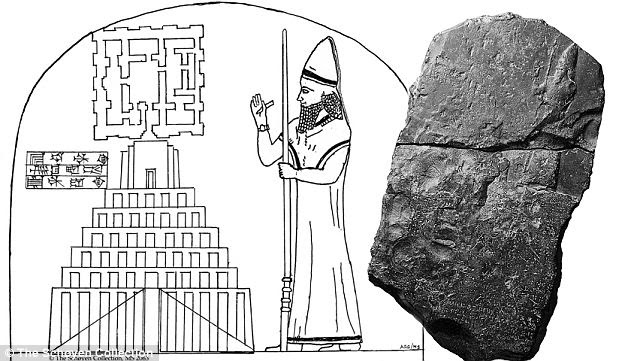
 

Sunday, May 26, 2019

Shalmaneser V and Nebuchednezzar II were ‘camera-shy’?


 Tower of Babel tablet: A reconstruction of the tablet, right, showing what the images would have originally looked like before they faded

 
by
 
Damien F. Mackey


“… there is no known relief depiction of Shalmaneser V …”.


Such is the case according to the article, "Shalmaneser V and Sargon II", at: http://emp.byui.edu/SATTERFIELDB/Rel302/Shalmaneser%20V%20and%20Sargon%20II.htm
.... The revolt of Israel against Assyria during the days of King Hoshea, last king of Israel, brought on a siege by the Assyrians (1 Kings 17). The siege was led by Shalmaneser V, King of Assyria (there is no known relief depiction of Shalmaneser V). During the siege, he died. Sargon II replaced Shalmanezer V as King of Assyria, who finished the siege and sacked Samaria.
 
Whilst that may be surprising in itself, the fact is – I believe - that Shalmaneser (so-called V) was the same person as Tiglath-pileser (known as III) of whom there are plenty of depictions.
 
 
And the lack of apparent portraits of Nebuchednezzar II was part of Dr. I. Velikovsky’s reason for (rightly) seeking to find an alter ego for the Great King (though wrongly, I think, equating him with the Hittite emperor, Hattusilis). Velikovsky wrote in Ramses II and His Time, p. 184: “At Wadi Brissa in Lebanon, Nebuchadnezzar twice had his picture cut in rock; these are supposedly the only known portraits of this king”.

Wednesday, May 22, 2019

King Nabonidus like an Assyrian monarch


Ashurbanipal 

 by
 
Damien F. Mackey


Nabonidus is an Assyrian king.
He adopts Assyrian titulature and boasts of having
the Assyrian kings as his "royal ancestors".


This is what I wrote some years ago now to Johnny Zwick, sysop of the California Institute for Ancient Studies (then www.specialtyinterests.net/), regarding my projected realignment of late Judah with neo Assyro-Babylonia:
 
My connecting of Hezekiah of Judah with Josiah went down like a lead balloon amongst the few to whom I sent it. (See Pope’s valuable effort at: http://www.domainofman.com/book/chart-37.html)
 
[Comment: I have since re-done this properly in my article:

 
'Taking aim on' king Amon - such a wicked king of Judah


So here is the next phase. I would not actually call it a bombshell.
More like a Third World War.
Nabonidus is an Assyrian king. He adopts Assyrian titulature and boasts of having the Assyrian kings as his "royal ancestors". There is nothing particularly strange about his supposed long stay in Teima in Arabia. This was a typical campaign region adopted by the neo-Assyrian kings. There is nothing particularly remarkable about his desire to restore the Ehulhul temple of Sin in Harran.
Ashurbanipal did that.
 
Nabonidus is said to have had two major goals, to restore that Sin temple and to establish the empire of Babylon along the lines of the neo-Assyrians. Once again, Ashurbanipal is particularly mentioned as being his inspiration.
 
Nabonidus was not singular in not taking the hand of Bel in Babylon for many years, due to what he calls the impiety of the Babylonians. Ashurbanipal (and now you will notice that he keeps turning up) could not shake the hand of Bel after his brother Shamash-shum-ukin had revolted against him, barring Babylon, Borsippa, etc. to him. He tells us this explicitly.
 
Nabonidus is not singular either in not expecting to become king. Ashurbanipal had felt the same.
So, basically Nabonidus is Ashurbanipal during his early reign. They share many Babylonian building works and restorations, too.
 
Now, if Nabonidus is Ashurbanipal (and I am now pretty much convinced that he must be), then Ashurbanipal of 41-43 years of reign (figures vary) can only be Nebuchednezzar II the Great of an established 43 years of reign.
Nebuchednezzar is the Babylonian face, while Ashurbanipal is the Assyrian face.
The great Nebuchednezzar has left only 4 known depictions of himself, we are told. Ridiculous! Add to this paltry number all of the depictions of Ashurbanipal.
 
The last 35 years of Nebuchednezzar are hardly known, they say. Add Ashurbanipal (whose lack also in places is supplemented in turn by Nebuchednezzar/Nabonidus).
 
It is doubted whether Nebuchednezzar conquered Egypt as according to the Bible. Just add Ashurbanipal who certainly did conquer Egypt.
 
The many queries about whether an inscription belongs to Nebuchednezzar or Nabonidus now dissolves.
 
It was Nabonidus, not Nebuchednezzar, they say, who built the famous palace in Babylon.
Nabonidus's well known madness (perhaps the Teima phase) is Nebuchednezzar's madness.
Nabonidus calls Sin "the God of gods" (ilani sa ilani), the exact phrase used by Nebuchednezzar in Daniel 2:47 of Daniel's God ("the God of gods").
 
Looking for a fiery furnace? Well, Ashurbanipal has one. His brother dies in it.
“Saulmagina my rebellious brother, who made war with me, they threw into a burning fiery furnace, and destroyed his life” (Caiger, p. 176).
….
 

Thursday, May 16, 2019

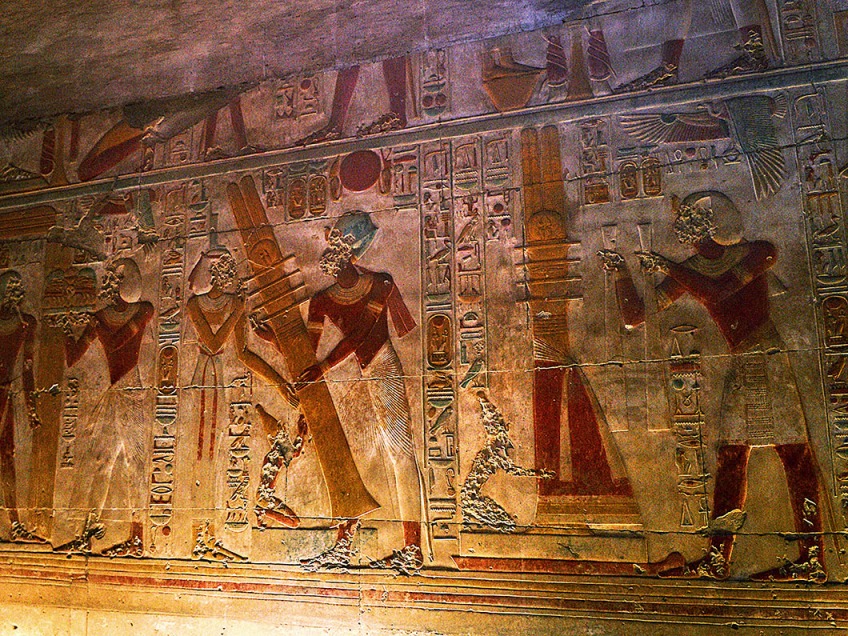
Conventional fudging has Seti occupying centuries


 Egyptian Temple relief


by
 
Damien F. Mackey


In the case of the so-called Twentieth Dynasty, Seti-nakhte, the heroic dynastic founder
who drove out the usurper, and who is Seti, rears up again in the guise of Ramses XI
at the end of that dynasty.


The characteristic feature of the early reign of Horemheb, of Seti, is restoration (and lawgiving) after a period of chaos and usurpation. Hence the institution of a new era, whm mswt (‘Repetition of Births’).
 
This connection between the Nineteenth Dynasty and, supposedly, the era the preceded it, is picked up again with Ramses XI, also (like Seti) named Menmare, with his new era of restoration, whm mswt.
Ramses XI is supposed to have reigned, like Horemheb, for 28 years.
 
Topsy-turvy Egyptian dynasties, as we noted elsewhere, with a dynasty’s beginning re-emerging at its end.
Thus, in the case of the so-called Twentieth Dynasty, Seti-nakhte, the heroic dynastic founder who drove out the usurper, and who is Seti (supporting the strong tradition of a “Sethos” as dynastic founder), rears up again in the guise of Ramses XI at the end of that dynasty. 
 
That is already a chronological stretch from c. 1320 BC (Horemheb) - 1070 BC (Ramses XI).
250 years for he who I consider to be the one pharaoh: Seti the Great.
 
And this does not yet take into account possible further extensions of Seti, via Psusennes I (=II) and on even into the 25th dynasty.


Wednesday, May 15, 2019

Merenptah completes Seti


by
 
Damien F. Mackey


“Merenptah’s involvement with the Osireion raises some questions,
not least, how did he gain access when the brick arch appears
to have been blocked up by Seti?”
 
Keith Hamilton


The somewhat poorly known pharaoh Merenptah - generally thought to have been the son and successor of Ramses II - needs, it seems, to be filled out with his supposed grandfather, Seti (the father of Ramses II), whom I have multi-identified in e.g. my series:
 
Seti I and Seti II Merenptah
 
See especially:
 
Seti I and Seti II Merenptah. Part Three: Seti I and II Merenptah and Merenptah
 
 
Merenptah’s relative obscurity (qua Merenptah) is apparent from the following quotes:
 
“Greatly overshadowed by his dominant and long-lived father, Merneptah never had a chance to become a famous pharaoh and he was almost unknown for most of his life”.
 
Note, in the next quote, the sequence: “probably”, “likely”, “presumed”, “possibly”.
 
“Merneptah was probably the fourth child of Isetnofret I, the second wife of Ramesses II, and he was married to Queen Isetnofret II, his royal wife, who was likely his full sister bearing the name of their mother. It is presumed that Merneptah was also married to Queen Takhat and one of their sons would succeed him as Seti II. They also were the parents of Prince Merenptah and possibly the usurper, Amenmesse, and Queen Twosret, wife of Seti II and later pharaoh in her own right”.
 
“He left few monuments, but in his conduct of Egypt’s defense and diplomacy he was at least the equal of his father”.
 
http://www.newadvent.org/cathen/10208b.htm
“His original works are comparatively few and insignificant. His name is constantly found on the monuments of his father …”.
 
Merenptah is thought to have “decorated” (in some cases, “largely”) monuments of Seti, even though he is considered to have been separated from Seti by the almost seven decades of reign of Ramses II.
 
“The Osireion is located behind the Abydos temple and may have been intended to be a 'cenotaph' (empty tomb.) The architecture of the Osireion is particularly unusual: a rectangular 'island' surrounded by a channel of water was constructed in the middle of the hall on which large pillars were built. This design may have represented the primeval waters and mound which began all of creation. Although the structure was built by Seti I it was largely decorated by his grandson, Merenptah with scenes from 'The Book of Gates', images of the journey to the underworld, texts relating to astronomy and depictions of gods and goddesses”. 
 
https://www.researchgate.net/profile/Keith_Hamilton4/publication/328225133_The_Osireion_A_Layman%27s_Guide/links/5bbf5cbe299bf1004c5a4617/The-Osireion-A-Laymans-Guide.pdf
“When Murray discovered and excavated the two chambers at the end of the entrance passage, she found them decorated with texts; she states,
 
“The cartouche of Merenptah appeared in every place where it could be inserted, and we therefore had to consider the possibility of its being his tomb.”24
 
It seems clear therefore, that a lot of the preliminary laying out of the texts was accomplished by Seti, and that these texts were utilised by Merenptah, who only had to sculpt the walls and replace Seti’s name with his own; though his workers appeared to have missed Seti’s name on two occasions.
 
There are indications that Ramesses II did likewise in the adjacent temple, when he completed Seti’s work; though there is no evidence that Ramesses did any work on the Osireion.
 
Merenptah’s involvement with the Osireion raises some questions, not least, how did he gain access when the brick arch appears to have been blocked up by Seti? Frankfort makes no comment on it, other than to question Strabo’s access; he states, Ingress could not be obtained by the arch at the north end of the entrance passage, because we found it still bricked up with Seti’s bricks,..”25
 
But if this logic is good for Strabo, what about Merenptah? Merenptah was Seti’s grandson and he ruled after his long lived father Ramesses II, who ruled about 66 years: Merenptah would not be so fortunate and his reign is believed to be a more modest 10 years. It would seem therefore, that Merenptah took an unusual interest in the subterranean Osireion some 66 years after Seti bricked up the arch. If Merenptah had used this entrance, might not he have used bricks with his own name on it? So how did he gain access? ….
 
“Children:  Little information about his children but it is believed that his son Seti-Merneptah became Pharaoh Seti II”.


Tuesday, May 14, 2019

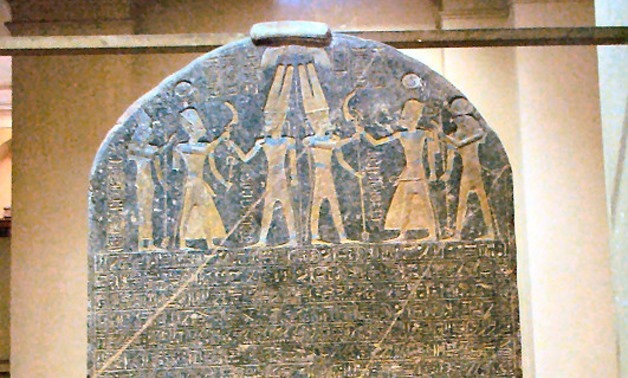
Seti Merenptah’s 'Israel' Stele


Merneptah Stele - Webscribe, Wikimedia Commons

by
 
Damien F. Mackey


Bimson thought (at least as late as 1980) that Merenptah’s Stele had pre-dated
the fall of Samaria by about a decade, to c. 734-733 BC; it being a reference rather
to the earlier Assyrian deportations of Israel by Tiglath-pileser III.


To recall what I have written previously:
 
– According to Courville, as we have seen, the stele’s inscription pertains to the Assyrian deportation of Samaria in c. 722/721 BC.
 
– Velikovsky would later look to connect it with the deportation of the Jews to Babylon after the sack of Jerusalem by Nebuchednezzar II [Ramses II and His Time, pp. 189-196]. Though Bimson has estimated Velikovsky’s date for the 5th Year of Merenptah at “no earlier than 564 BC … 23 years after the fall of Jerusalem” [‘An Eighth Century Date for Merenptah’, p. 57].
 
– Bimson thought (at least as late as 1980) that Merenptah’s Stele had pre-dated the fall of Samaria by about a decade, to c. 734-733 BC; it being a reference rather to the earlier Assyrian deportations of Israel by Tiglath-pileser III. …. [Ibid. See also ‘John Bimson replies on the “Israel Stele”,’ pp. 59-61].
 
– Rohl has in turn dated the conquests described in the stele to those effected by Seti I and Ramses II, his candidate for the biblical ‘Shishak’, himself regarding the stele as being Merenptah’s merely basking in the glory of what these, his great predecessors, had achieved before him. […. A Test of Time, ch. 7, pp. 164-171].
 
[End of quote]
 
For Drs. Velikovsky, Courville and Bimson (back then), this Egyptian Stele was supposedly commemorating one or another Assyro-Babylonian triumph – a most unlikely scenario! 
 
And Rohl, for his part, though regarding the document as being a commemoration of Egyptian victories, considered these to be triumphs pre-dating pharaoh Merenptah – victories by his predecessors, Seti I and Ramses II.  
 
Only Martin Sieff, amongst the revisionists, had envisaged this as being an Egyptian victory achieved by Merenptah himself.
 
Thus I wrote:
 
– And Sieff … related Merenptah’s victory to what he called the “time of troubles in the northern kingdom of Israel after the death of Jeroboam II”.
 
Martin Sieff’s realistic version, which is the one that I basically embraced in my postgraduate university thesis (Volume One, Chapter 11, pp. 300-305):
 
A Revised History of the Era of King Hezekiah of Judah
and its Background
 
 
was dependent upon the biblical chronology of Martin Anstey - and taken up by Philip Mauro - that the reign of Jeroboam II in Israel was followed by a 22-year period of interregnum.
 
Patrick Clarke
 
Rohl’s revised chronology, according to which Ramses II was the biblical pharaoh “Shishak” at the time of king Rehoboam of Judah (I Kings 14:25), has recently been picked up by Creationist, Patrick Clarke in his article, “The Stele of Merneptah—assessment of the final ‘Israel’ strophe and its implications for chronology”:
 
 It is clear that the Merneptah stele can be interpreted in line with the United and Divided Monarchy Periods of Israelite history. Furthermore, if it can be demonstrated that Merneptah’s father, Ramesses II, was in fact Shishak, many synchronisms previously held by both supporters of the CEC [conventional] and revisionists between the people of Israel and their neighbours collapse, and a whole new series of compelling synchronisms emerges. The reigns of Ramesses II and Merneptah are contemporaneous with the last few years of the United Monarchy and the first 75 years of the Divided Monarchy. A detailed analysis of the ‘Israel’ text indicates that far from being placed in the 1200s bc, Merneptah’s reign should be dated to 913–903 bc; a movement of three centuries. Consequently, Ramesses II would have reigned from 979–913 bc, in the Divided Monarchy Period. In my proposed revised chronology all the political, military, and economic factors detailed on the stele coincide with conditions in Israel. This was not the case three centuries earlier in the time of the Judges.
[End of quote]
 
Whilst Clarke is correct in rejecting the conventional location of the Merenptah Stele to the approximate period of “the Judges”, his chronological re-setting of Ramses II and Merenptah has, in my opinion, dire consequences for the best efforts of the revision as explored by the likes of Drs. Velikovsky and Courville, and modified and enhanced by astute minds of the “Glasgow School” (including Martin Sieff).
For, as Clarke goes on to write:
 
Once this historical re-alignment takes place, a number of synchronisms previously held to be true by some revisionists, albeit well-intentioned, are refuted. Some of these erroneous synchronisms are: Thutmose III/Shishak;31 Hatshepsut/Queen of Sheba;32 Amenhotep II/Zerah the Cushite; Israel’s King Ahab/Battle of Qarqar; Israel’s King Jehu/Shalmaneser III—the final two failed synchronisms in this list have serious implications for the less than reliable Assyrian chronology.33
[End of quote]
 
No thank you. I myself shall stick with the, now manifold, synchronisms - as worked out by revisionists - between Egypt’s 18th dynasty and the United to Early Divided kingdom periods, especially those iron-cast synchronisms with El Amarna.
 
Clarke’s most useful contribution is, in my opinion, his expertise in Egyptian Hieroglyphics, which he has correctly noted has not been a strong suit amongst revisionists: “Knowledge of the Egyptian language and syllabic orthography is essential when assessing any Egyptian text, otherwise mistakes are inevitable”. Thus Clarke writes with regard to the Stele: 
 
This reliance in Christian works on blind copying of old, outdated translations, which probably reflects the dearth of competent archeology and history specialists in the Christian community, is fraught with problems, as will be seen.
 
Knowledge of the Egyptian language and syllabic orthography is essential when assessing any Egyptian text, otherwise mistakes are inevitable. The majority of Egyptologists are in agreement regarding the entity ysry3l as Israel based on the syllabic orthography of the name and the context of the final poetic unit of the Merneptah stele. It is the chronological placement of Israel where scholars of the CEC and revisionist positions come into conflict.
[End of quote]
 
Clarke is particularly scathing about professor Joseph Davidovits, whom he calls “A secularist”, regarding the latter’s unorthodox translation of the Victory Stele (see Clarke’s section on p. 62: “A secularist attempt to deny Israel is even mentioned on the stele”).
 
A suggested solution
 
With my modification of the Nineteenth Egyptian Dynasty in its relation to Seti and the awkward Third Intermediate Period in multi-part series such as:
 
Smendes and Shoshenq I
 
beginning with:
 
 
and:
 
Seti I and Seti II Merenptah
 
beginning with:
 
 
I am now inclined to accept Rohl’s and Clarke’s opinion that the Israel Stele pertains to an early Nineteenth Dynasty ruler, such as Seti – but with my twist to this, that Seti was Merenptah.
 
See especially my article on this:
 
Seti I and Seti II Merenptah. Part Three: Seti I and II Merenptah and Merenptah